
The Han Court’s Captivity and Collapse
The Romance of the Three KingdomsThis flow traces how imperial institutions survive successive crises in name while their practical authority passes to military powers.
increasing Bearing strength in each event
 decreasing
Bearing strength in each eventdecreasingThe Ten Attendants

A Court Captured From Within
Access as Power
The Ten Imperial Attendants control access to Emperor Ling and influence who receives office or punishment.
Rebellion Spreads
The court’s inability to act effectively fuels popular unrest. The dynasty still possesses institutions, but their loss of credibility makes local military power more attractive.
The He Jin Crisis

A Palace Opens to Armies
A Dangerous Strategy
He Jin summons regional troops to destroy the eunuchs despite warnings from Cao Cao and Lu Zhi.
Assassination and Chaos
The eunuchs kill He Jin, and his allies storm the palace. The action destroys the immediate faction but allows Dong Zhuo to seize the larger state.
Emperor Xian’s Flight
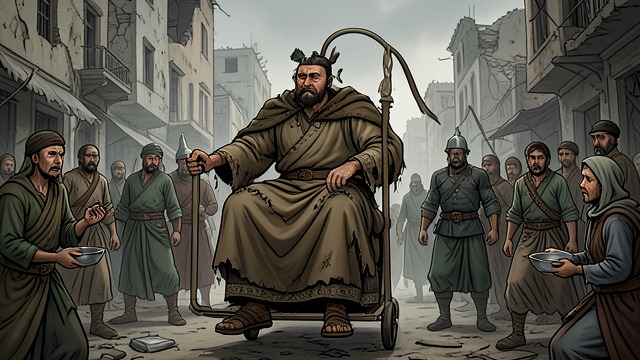
The Sovereign as Captive
Factional Warfare
Li Jue and Guo Si fight for control of the court and seize the emperor during their conflict.
Return to Ruins
With the help of loyal commanders, Emperor Xian reaches Luoyang, only to find the capital devastated and the court starving. Survival replaces government as the immediate concern.
Cao Cao Moves the Court

A Protector Takes Control
Military Rescue
Cao Cao defeats the immediate threats to Emperor Xian and presents himself as the court’s defender.
New Center of Power
He relocates the emperor to Xuchang, where the court is safer but dependent on Cao Cao’s army and decisions.
Imperial Authority Transfers

Ceremony Follows Force
The Han’s End
Cao Pi compels Emperor Xian to abdicate and establishes Wei. Xuande claims the Han succession in Shu, contesting the new order.
Wei’s Replacement
Sima Yan later compels Cao Huan to abdicate. The successive transfers reveal how ritual language accompanies the repeated capture of practical power.
During Emperor Ling’s reign
AD 189
During Li Jue and Guo Si’s conflict
AD 196
From AD 220 to AD 265
